
Search Jacksonville Voter Registration
Begin at the official NCSBE Voter Search. Enter the registered first and last names, select at least one status, and set County to Onslow when the person is tied to Jacksonville. A middle initial and birth year help separate people with similar names. Choose a plausible result, then review the full profile and scroll to the sample-ballot area. JavaScript must be enabled.
| Search label | Control | Needed? | How to use it |
|---|---|---|---|
| First Name | Text | Yes | Use the name on the registration. |
| Middle Initial | Text | No | Enter one letter to narrow a common name. |
| Last Name | Text | Yes | Use the registered surname. |
| Year of Birth | Dropdown | No | Choose a year when known; the list is dynamic. |
| County | Dropdown | No | Select Onslow from all 100 counties. |
| Voter Status | Checkboxes | At least one | Choose Registered, Removed or Denied, or both. |
The official Jacksonville voter lookup screen shows the precise name, county, and status controls used for this search.
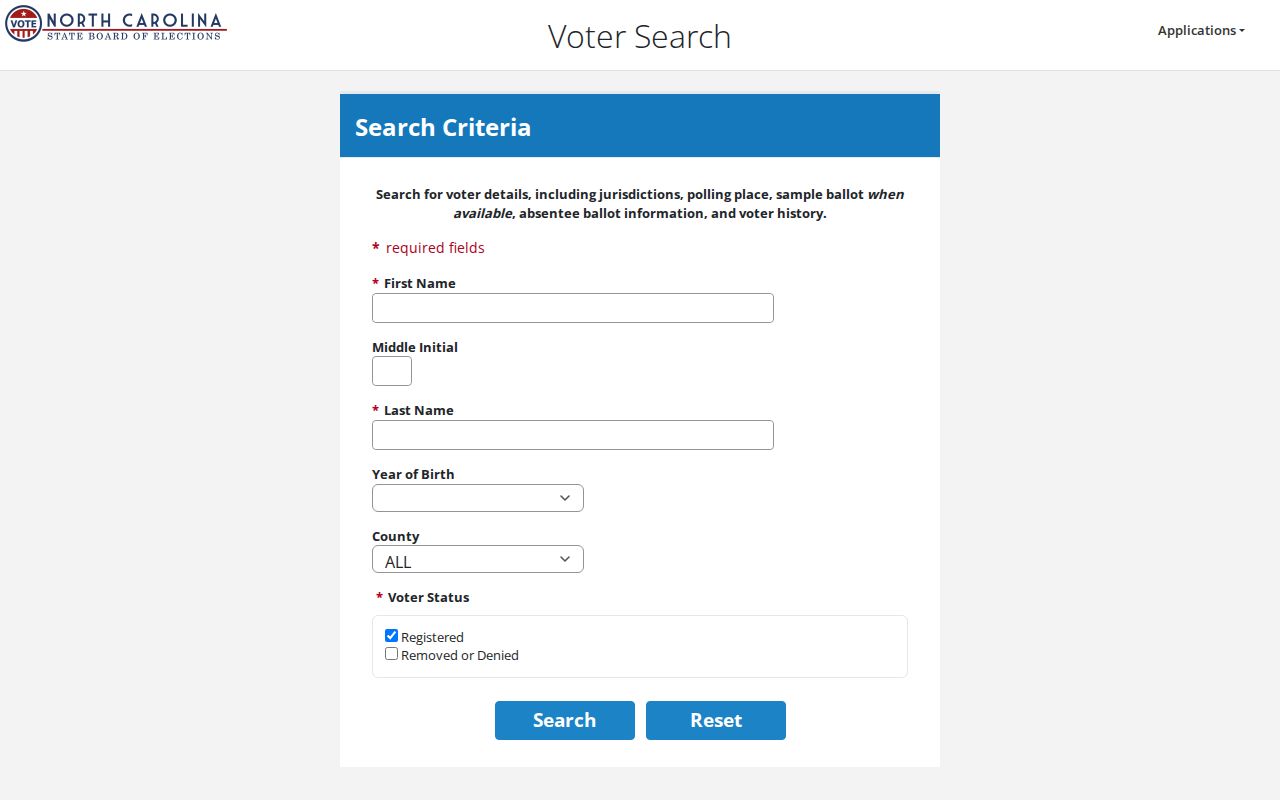
The screen confirms that a birth year and county refine the search without making either field mandatory. This is a person-by-person lookup, not the efficient route for browsing the full Onslow roll.
Jacksonville Voter Record Profile
A matching NCSBE profile is more than a yes-or-no registration check. The voter-details block identifies county, status, party, the county-unique registration number, and the statewide NCID. Jurisdiction fields can include precinct, Congress, North Carolina Senate and House, Superior Court, judicial and prosecutorial districts, county commissioner, school, and municipal council or ward where applicable.
| Voter details | County, status, party, county voter number, and NCID |
|---|---|
| Districts | Precinct plus federal, state, judicial, county, school, and applicable city assignments |
| Voting locations | Upcoming polling site and address, early-voting route, and county board contact |
| Ballot tools | Eligible sample ballot and mail or early-voting status fields when available |
| Voter history | Election, method, county, and primary-election ballot category |
For a primary, the sample ballot reflects party rules; an unaffiliated voter may see choices for an open primary. The profile can also show absentee status, type, return date, return method, and return status. Those administrative fields can lag while Onslow officials finalize election data.
Jacksonville Voter Fields Matrix
North Carolina treats the voter roll as public, but it does not publish every item supplied during registration. N.C.G.S. §163-82.10 governs the core split, while §163-82.10B addresses birth-date confidentiality. The result is a field-level rule, not an all-open or all-closed record.
| Public or available list field | Confidential or not copied |
|---|---|
| Name, county voter ID, residential and mailing address | Full or partial Social Security number and date of birth |
| Sex, race, age, party, registration date | Driver-license number and registration-agency identity |
| Precinct and listed federal, state, judicial, county, and local districts | Protected email details, voter-ID photos, and ID photocopies |
| Status, status reason, participation election and method | Protected actual address and every ballot choice |
Confidential by statute. A Jacksonville voter’s birth date, Social Security and driver-license numbers, protected email or ID material, and qualifying protected address are withheld. A signature may be viewed under the statutory rules, but the public may not copy or trace it.
Jacksonville Voting History Myth
Voter history answers whether a person participated in a named election, the method used, and the county where that participation was recorded. In a primary it may identify the party primary. It does not show a candidate, contest choice, referendum response, or marked ballot. Ballot secrecy remains intact.
The distinction matters when reviewing Jacksonville voter records. “Voted Method” can describe in-person, early, or absentee participation, but it is not a political preference. Participation may also take several weeks to appear while county data are finalized. Treat a recent blank as unfinished administration, not proof that someone did not vote.
Myth: A voter profile reveals how someone voted. Fact: It reports participation and method only, never candidate or ballot selections.
Download Jacksonville Voter Rolls
The standard full-file route is the NCSBE Current Voter Registration Data page. It offers a statewide ZIP and a separate download for each county, including Onslow. There is no purchase application, access gate, or charge for the standard files. NCSBE updates them on Sunday evenings, although election finalization can take additional days.
- Open the current registration-data page and locate the county downloads.
- Choose Onslow County for a Jacksonville-focused file, or the statewide ZIP for a broader search.
- Download the matching file layout before interpreting columns, codes, status reasons, or district fields.
- For participation, download the separate Voter History Data and join it by NCID, or by county plus registration number.
The NCSBE download page displays the current and historical file choices used for Jacksonville roll research.
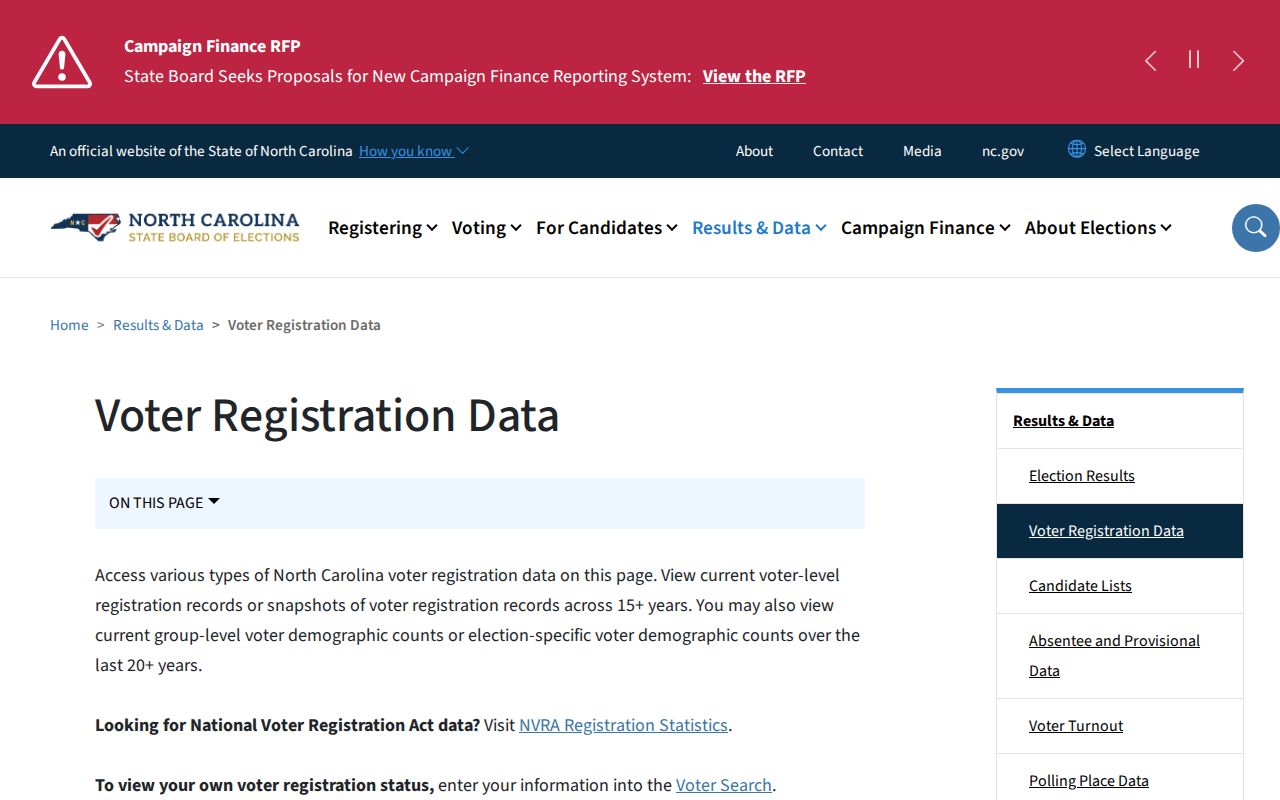
The registration file supplies the public person and registration fields. The history file covers ten years at individual level and omits names and demographics until joined; older registration snapshots span more than 15 years, while aggregate election statistics extend more than 20 years.
Jacksonville Voter Data Statuses
The downloadable file is broader than a list of currently registered people. It includes public information for registered and formerly registered people, plus attempted or incomplete registrations. The individual lookup can search Registered and Removed or Denied statuses. Status and reason fields must be read together rather than reduced to a simple present-or-absent conclusion.
Removed voters drop from the current public file when their most recent last-voted date is more than ten years old. That retention rule means the current roll is not a complete historical census of everyone who ever registered in Jacksonville. Historical snapshots may preserve an earlier appearance, but they still reflect the published file as it existed then.
Address, name, or party changes require an updated registration. A registrant moving within Onslow County may correct the voter card, sign it, and mail it. When a profile looks stale, confirm the current status through the lookup or ask the elections office to interpret the record.
Protected Jacksonville Voter Records
A public roll does not override a safety protection. A qualifying person with a Chapter 50B protective order, or an active North Carolina Address Confidentiality Program authorization card and safety statement, can have the actual residence address shielded while the protection remains effective. The substitute address can be used for election enrollment and other public-facing government records.
The protection is precise rather than total. A protected voter’s name, precinct, and other public election data can remain visible even though the residence is withheld. The authorization card is also not voter photo identification. A person seeking protection should follow the Attorney General’s Address Confidentiality Program guidance and present the required card and signed jeopardy statement to the county board.
Onslow Channels for Jacksonville Voters
The Onslow County Board of Elections is the local custodian and the fallback when a web profile is unclear, a custom selective list is needed, or a Jacksonville voter needs help correcting a record. The office is at 246 Georgetown Road, Jacksonville, NC 28540. It is open Monday through Friday, 8:00 a.m. to 5:00 p.m.
Onslow Board of Elections
Phone: 910-455-4484
Fax: 910-455-1390
Email: OnslowBOE@onslowcountync.gov
Director: Jessica O’Neill
The county election-services page presents the office contacts and routes behind local voter-record help.
The counter can support public inspection, custom lists, and record interpretation. Selective lists may use lawful categories such as party, gender, race, registration date, precinct, district, name, or voting history. A custom list may carry the county’s actual preparation cost, unlike the free standard download.
Absentee-request information has its own timing rule. The request register is confidential before Election Day under N.C.G.S. §163-228. Public absentee and provisional datasets become available only at the statutory point; counties cannot disclose identifying request data before polls open.
Lawful Jacksonville Voter Record Use
Use Jacksonville voter rolls for lawful civic research, checking one’s own status, or understanding precinct and district assignments. Do not use an address or participation detail to stalk, harass, threaten, track, or impersonate anyone. North Carolina laws address stalking, cyberstalking, and fraudulent use of identifying data, with penalties that can rise when conduct is repeated or violates an order.
Confusing official datasets can lead to serious misuse. The North Carolina SBI registry is a separate system with its own name and geographic search rules.
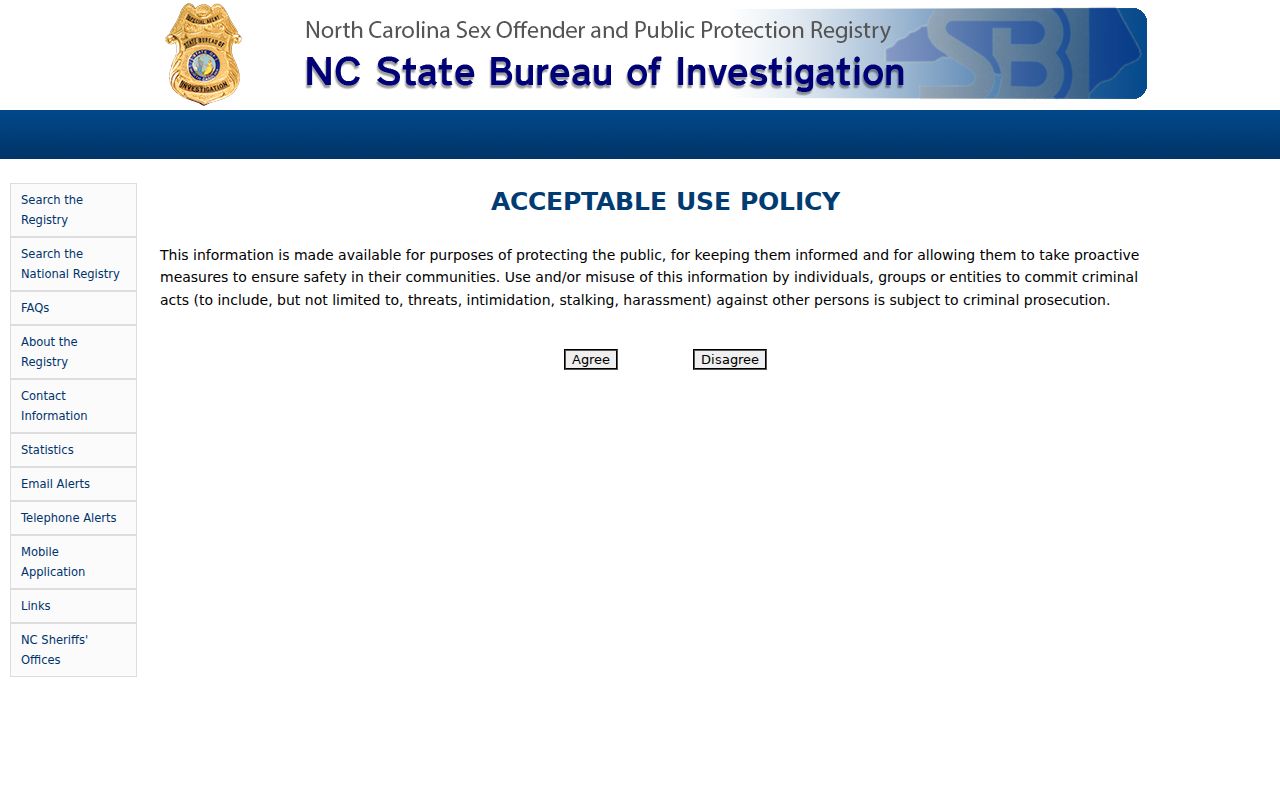
A result in that registry neither proves nor disproves current voter registration, and a voter-file address must never be used to target a person. Keep each record tied to its actual custodian, legal purpose, and date.
Jacksonville Election Records Gaps
Modern files should not be projected backward without evidence. The North Carolina State Archives inventory lists Onslow election records from 1790 through 1887 within a miscellaneous county collection. Researchers should not describe that span as a continuous set of poll books or registration registers. The research did not establish exact years for local paper poll books, so an archive inquiry is the honest next step.
Jacksonville’s civic geography also changed dramatically after the 1940 military-base decision, later growth, and annexation. A historical voter or address may fall under a boundary that differs from today’s city, base, or county lines. Search the archive’s election material by the period and jurisdiction actually in force, then use newspapers, census schedules, city directories, or land records to fill gaps without claiming that those sources prove registration.
Current data have limits too. Individual history covers ten years, historical registration snapshots extend more than 15 years, and aggregate election figures go back more than 20 years. Those three products answer different questions and should not be treated as one continuous Jacksonville voter record.