
Jacksonville Public Records Inventory
Jacksonville has no single records desk or universal portal. Onslow County land instruments sit with the Register of Deeds. Court and estate files belong to the Clerk of Superior Court. The Tax Office and GIS maintain parcel data, while city departments hold Jacksonville permits, code files, board material, cemetery records, and police reports. North Carolina law opens many existing government files, but a separate statute can withhold a field, document, or whole case.
| Record Set | Custodian | Online Index | Access |
|---|---|---|---|
| Deeds, liens, plats, UCC | Onslow Register of Deeds | eSearch; real estate index from 1977 | Guest search, counter, mail, library, archives |
| Court, divorce, estates | Clerk of Superior Court | eCourts Portal | Public summaries, terminal, paper file, copies |
| Property, taxes, GIS | Tax Office and GIS | Tax search and Online Map Service | Free current views; counter and data request |
| Birth, death, marriage | Register of Deeds and NC Vital Records | Local index ranges vary | Field and certified-copy limits apply |
| City permits and administration | Jacksonville departments | No complete public index found | NextRequest, phone, or City Clerk |
| Custody and registry | Sheriff, NC DAC, NC SBI | Separate official tools | App, booking desk, or statewide search |
Access is not the same as unrestricted use. Sealed and expunged cases, juvenile and adoption files, protected voter addresses, sensitive vital fields, Social Security numbers, restricted military discharges, and DMV personal data do not become open merely because related material is online. A portal result is also an index, not always the filed image or an authenticated copy.
Note: The official custodian, not a reused tax or map display, controls the source record and any certified copy.
Chapter 132 Opens Jacksonville Records
North Carolina Chapter 132 treats records made or received while conducting public business as government property unless another law creates an exemption. Any person may inspect them at reasonable times and under reasonable supervision. There is no state residency test. Section 132-6 requires copies “as promptly as possible,” but North Carolina sets no fixed number of business days.
A Jacksonville requester may choose a medium the agency can provide. An uncertified copy is capped at direct, actual reproduction cost. Ordinary overhead is excluded. A request that demands unusually extensive technology, clerical, or supervisory work can draw a reasonable special service charge, so ask for an estimate first. The custodian need not create a new report, answer legal questions, or compile information it does not already maintain.
Response-time myth. A quiet portal inbox does not trigger an automatic deadline violation after a set number of days. Promptness depends on the request, though the custodian must still act reasonably.
Onslow eSearch Records and Dates
The Onslow Register of Deeds eSearch allows guest entry, so an account is not required for a basic Jacksonville name search. Accounts add saved work and some payment or subscription functions. The office reports deed books dating to 1734, but that date does not describe the searchable party index. Certified online real-estate coverage begins with pre-1995 records from January 1, 1977, followed by consolidated real property from January 1, 1995.
| Search route | Input | Required | Use |
|---|---|---|---|
| Quick Name | Party name | For that route | Fast grantor or grantee search |
| Advanced Name | Name plus refinements | Varies | Narrow a common name |
| Property | Property or legal-description terms | Varies | Find land-linked instruments |
| Book/Page | Book and page pair | Both | Open a known placement |
| File Number | Instrument or file number | Yes | Direct document retrieval |
| Date Range | Beginning and ending dates | Both | Limit recordings by time |
Birth indexing begins in 1857, death indexing in 1912, and marriage indexing in 1962. Notary and UCC groups begin in 1995. Check the Certified Dates utility because each group has its own through-date. An index entry can identify a party role, instrument type, recording date, book/page or file number, property terms, and an image link when available.
Note: For pre-1977 deeds, take names, approximate years, subdivision or township, and any book/page reference to the counter.
Jacksonville Property and GIS Records
The Onslow property search accepts an owner name, property address, account number, parcel ID, alternate parcel ID, or tax year and bill number. An unpaid-only filter can narrow tax bills. Once the parcel is known, the Online Map Service adds mapped boundaries, addresses, zoning, flood, school, fire, and other planning layers. Those tools describe different parts of the same land record system.
A tax owner is the name on the current roll. GIS depicts parcel geometry and jurisdiction. The recorded deed is the transfer instrument. Onslow GIS warns that a new deed can appear before an online ownership display catches up because the transfer moves through several county departments. For the newest Jacksonville transfer, compare the deed’s recording date with the roll rather than treating a web mismatch as proof that one record is false.
A Jacksonville mailing address may sit in city limits, the extra-territorial jurisdiction, Marine Base, or unincorporated Onslow County. Postal wording alone does not identify the permit or code custodian. That boundary check can prevent a request from reaching the wrong office.
Jacksonville Court Records After eCourts
Onslow joined North Carolina eCourts on February 3, 2025. The public eCourts Portal supports anonymous Smart Search, Search Hearings, and NC Judgment Search. A person, business, nickname, or case number can lead to a public summary. Advanced filters include Onslow location, party details, case type, status, and filing dates. Wildcards help with variant spellings, but the portal enforces minimum character rules.
Public results may show a case number, parties and roles, a register of actions, causes, events, dispositions, hearings, and some financial data. A docket is the chronological case activity log. It is not the same as each filed pleading or order. Paper and public electronic files remain with the Onslow Clerk of Superior Court, and courthouse terminals provide another search channel.
Older files may be archived through the clerk. Sealed, expunged, juvenile, adoption, and other confidential material stays restricted. Federal cases use PACER and the Eastern District of North Carolina, so a state portal miss does not rule out a federal docket.
Jacksonville Vital Records Access
North Carolina does not use a simple rule that all births close for one period and all deaths for another. N.C.G.S. §§130A-93 and 130A-99 set field-level limits and certified-copy eligibility. The Onslow Register of Deeds issues county birth, death, and marriage certificates. NC Vital Records handles statewide events, while a divorce decree remains with the Clerk of Superior Court.
The county records request instructions document mail and counter access. A mail request needs the person’s or record’s names, event date, certificate count, picture ID copy, self-addressed stamped envelope, and the correct payment. A birth request also asks for the mother’s maiden name. Mail goes to Register of Deeds, 109 Old Bridge Street, Jacksonville, NC 28540. The office does not send vital records by email or fax.
The local request channels and form links appear in the official county capture:
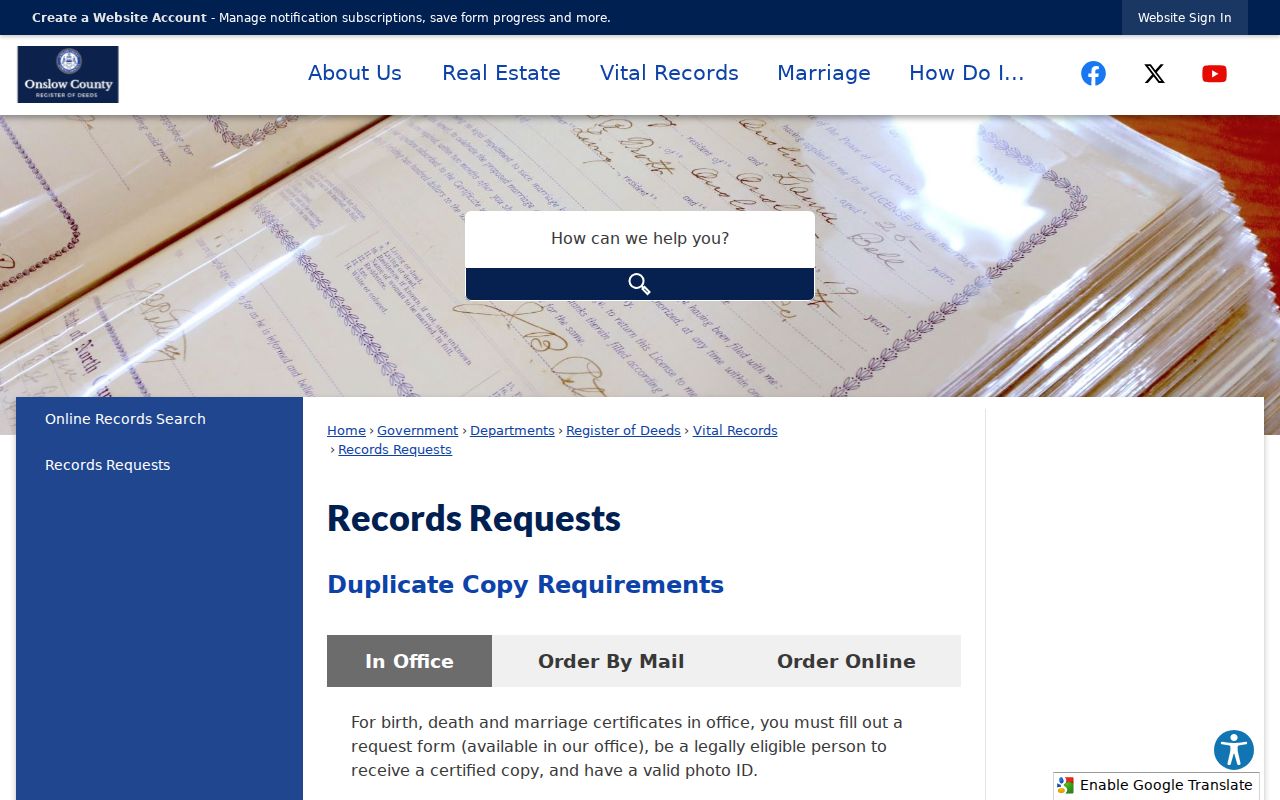
The capture is a useful route to the live instructions, but eligibility and payment details should always be checked before mailing.
Jacksonville Records Offices and Portals
Because Jacksonville is the Onslow County seat, the principal land and court desks are in town. Use the office that created or keeps the record. The Register of Deeds is not a general county clerk, and the elected Clerk of Superior Court does not hold deeds or marriage licenses. Calling ahead is wise when an old volume, archived court file, copy quote, or appointment may be needed.
Onslow Register of Deeds
602 Anne Street
Jacksonville, NC
910-347-3451
Monday through Friday, 8:00 to 5:30
Onslow Tax Office
234 NW Corridor Boulevard
Jacksonville, NC
910-989-2200
Parcel and tax records
Clerk of Superior Court
625 Court Street
Jacksonville, NC 28540
910-478-3600
Monday through Friday, 8:00 to 5:00
Jacksonville City Clerk
815 New Bridge Street
Jacksonville, NC
910-938-5224
Help Monday through Friday, 8:00 to 5:00
City agency records
Jacksonville City Records Use NextRequest
Jacksonville city departments use NextRequest for council, board, contract, permit, inspection, code, cemetery, police, and other municipal records. The city says email requests are no longer accepted. No complete public citywide permit, code-case, cemetery-interment, alarm, or business-license index was found. An online absence is therefore not evidence that a city file does not exist.
Describe the department, record type, date range, address, names, and any permit or case number. Ask for electronic or paper delivery. The Onslow County Form Center is a discovery surface for departmental forms, not a search of the records produced from those forms. The official Onslow Form Center capture shows why a category page should not be mistaken for an index:
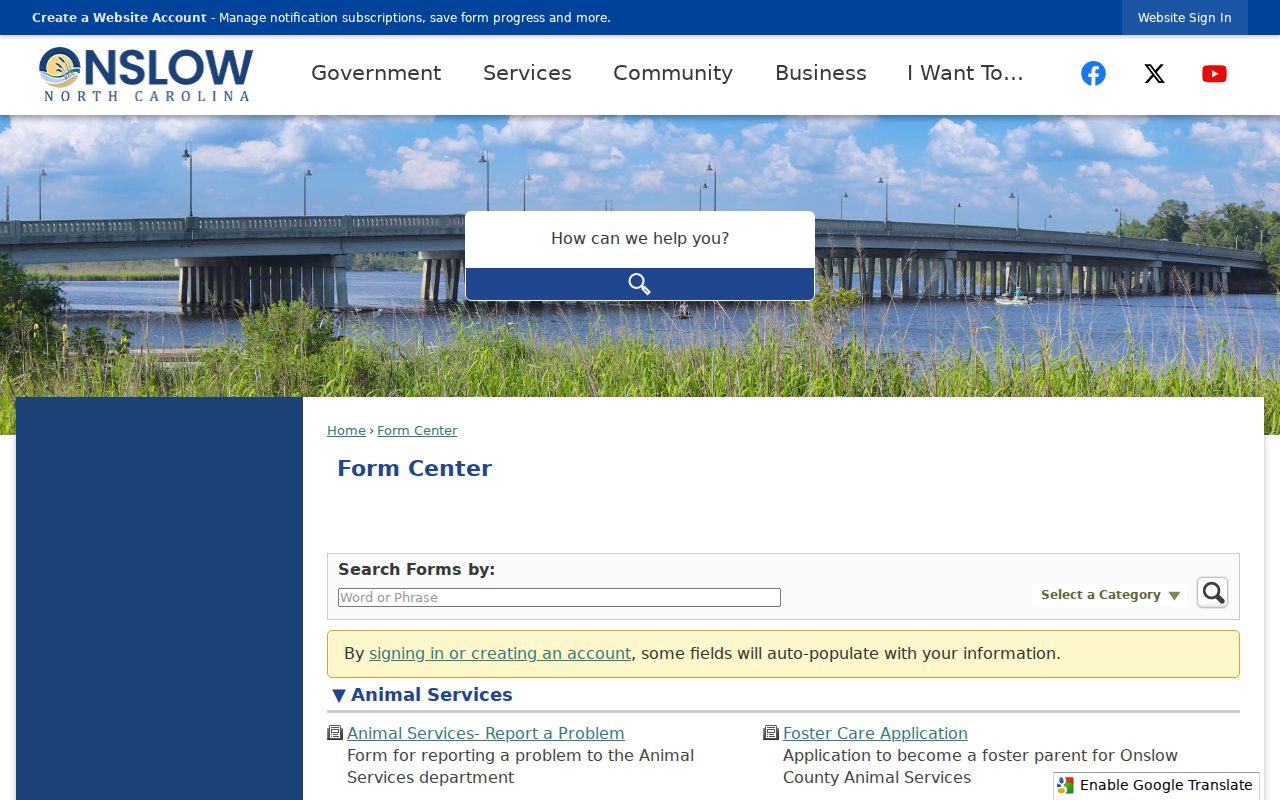
The form categories can identify the likely county unit, but a named existing file still has to be requested from its custodian.
Note: City code and permit files depend on jurisdiction, so confirm city limits or ETJ status before choosing NextRequest.
Jacksonville Record Fees and Copies
Cost depends on whether the requester wants inspection, a plain copy, a certified copy, or a recording service. At the Register of Deeds, an uncertified in-house page costs 10 cents, a mailed copy costs $1, and a certified document costs $5 for the first page plus $2 for each added page. A local certified vital certificate costs $10. County mail instructions reject checks for vital requests.
NC Vital Records charges a nonrefundable $24 search covering three years and the first certificate, then $15 for each additional copy of the same record. Court copy and certification fees come from the clerk. GIS web viewing is free, though print sizes and data services can have charges. Under §132-6.2, an ordinary records copy cannot include general overhead, while an unusually extensive request may carry an actual-labor special service charge.
Can a screen result replace a certified copy? Usually not when authentication matters. The screen is a search aid, the image is the filed content, and a certified copy carries the custodian’s formal attestation.
When Jacksonville Records Stay Restricted
Open government law works beside many confidentiality laws. Court-sealed and expunged cases, juvenile records under §7B-3000, adoption material, protected family and mental-health content, Social Security numbers under §132-1.10, DMV personal data, DD-214 military discharges, and Address Confidentiality Program locations may be unavailable or redacted. A protected field does not always justify withholding every separable public field.
- Index
- A searchable list that points to a record by name, date, number, or category.
- Image
- A scan or electronic view of the filed document, which may contain more detail than the index.
- Certified copy
- A copy formally authenticated by the office that keeps the original record.
- Custodian
- The government office responsible for maintaining and releasing a record.
- Exemption
- A statute or rule that permits or requires specific information to be withheld.
North Carolina’s Address Confidentiality Program provides a substitute address to eligible survivors who have moved or plan to move. Agencies keep the actual address out of open files. The Register of Deeds also accepts a free online-display redaction request under §132-1.10(g) when the requester supplies the document book/page and exact location of personal information. That step does not erase the underlying official instrument.
Jacksonville Offline Records Channels
Every major Jacksonville record trail has a fallback when a web search fails. Deed researchers can use the Register of Deeds counter, call for a book/page quote, mail a precise citation, or work through microfilm and archives. Court researchers can use courthouse terminals and inspect a public file at the clerk. Property researchers can call the Tax Office or GIS and request an existing parcel card, tax bill, ownership extract, or dataset.
The Tucker Littleton Room at Jacksonville Main Library provides an important historical bridge. Its resources include early deed and vital microfilm, land entries, wills, tax lists, court minutes, HeritageQuest, and in-library Ancestry access. The official library database listing shows those research routes:
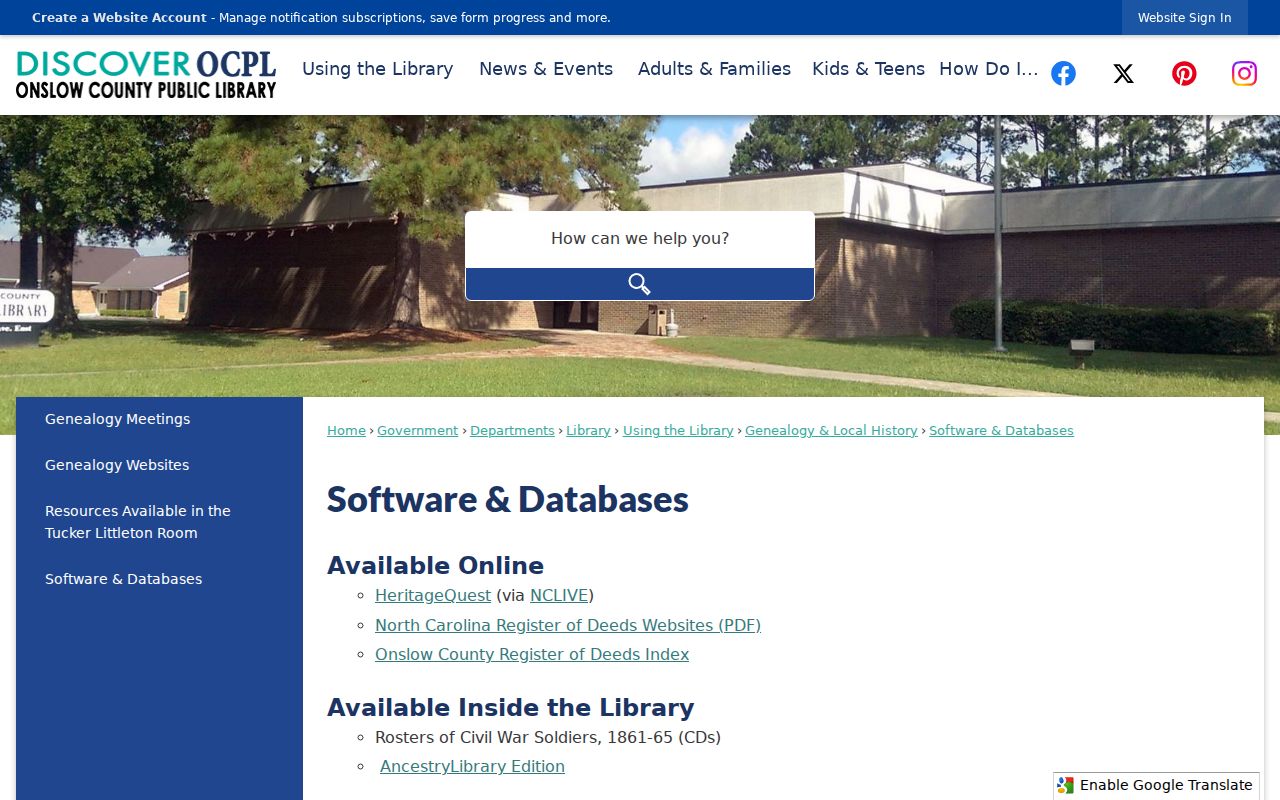
These holdings matter most where a modern name index stops. They can reveal an older book reference that staff can then confirm in the official land, court, or vital series.
For current Onslow jail information, use the Sheriff’s mobile app or booking desk at 910-937-1470. The county does not post the roster and mugshots on its regular website. NC DAC is a separate statewide route for prison, probation, and parole history dating to 1972. The NC SBI registry supports name, address-radius, coordinate, and registration-number searches. Sheriff incident files go to the Sheriff’s records channel, Jacksonville Police files go through NextRequest, and federal custody uses the BOP locator. SAVAN/VINE supplies status alerts, not a court disposition.
Request Jacksonville Public Records
A useful request asks for an existing series, not a broad investigation. First find the custodian, then check its index and coverage dates. Give enough detail for staff to identify the file without asking the agency to conduct research. Chapter 132 does not require a requester to explain a motive. For Jacksonville city material, submit through NextRequest. County and court channels vary by office.
- Name the custodian and series. Distinguish deeds, court cases, tax parcels, city files, and state records.
- Search the portal first. Save the coverage date, case number, parcel ID, book/page, or other citation.
- Describe the existing record. Supply names, spelling variants, dates, address, department, and known identifiers.
- Choose the format. Separate inspection, plain electronic copy, paper copy, and certification, then request a fee estimate.
- Keep the receipt. Save portal confirmation, correspondence, quoted cost, and delivery metadata.
- Address a denial. Ask for the precise statutory basis in writing and whether redacted public portions can be released.
If a charge seems too high, ask how direct reproduction cost or extraordinary labor was calculated. Narrowing a date range or naming a record series may reduce work. If access is denied, §132-9 supplies a civil enforcement route in Superior Court. Judicial Branch administrative-record denials also have NCAOC review and optional prelitigation mediation, which are distinct from appeal of a court judgment.
Lawful personal use. Use open records for lawful research, civic review, family history, property checks, or scam prevention. Never use a name, address, image, or case detail to stalk, threaten, harass, or harm anyone.