
Find People Through Jacksonville Records
Start with the fact already in hand. A full name can lead to the Onslow County deed index, the state court party search, voter registration, business filings, or an official staff directory. An address works better in the county tax search and map viewer. An older address may require a reverse city directory instead. Phone books and newspapers help when the person was an occupant but never owned the home.
Jacksonville is the Onslow County seat, so the main county counters sit in the same city. Still, each office keeps a different part of a person’s trail. The Register of Deeds holds land and local vital records. The Clerk of Superior Court keeps case and estate files. The Tax Office ties owner names to parcels. The Board of Elections manages local registration records through state systems.
- Search the most direct official index with the name, address, parcel, or case number you know.
- Limit statewide court and voter results to Onslow County, then compare middle initials, dates, and roles.
- Pivot from an address to the tax parcel, mapped jurisdiction, newest deed, and earlier owners.
- Use directories, newspapers, and library files for occupants who do not appear in title records.
- Contact the true custodian when the online index is too new, incomplete, protected, or unavailable.
Jacksonville People Search Offices
There is no single Jacksonville records desk. The office depends on what the name is meant to prove. A deed shows a recorded party and transfer, not necessarily a current home. A tax roll identifies the owner carried on the parcel account. A court docket shows a party’s role and the case history that is public. City departments keep municipal permits, code, board, cemetery, and administrative records.
The full access rules, copy fees, and request steps are covered with the Jacksonville public records system. These local counters are the best starting points when an online search needs a book, image, certified copy, or staff help.
Jacksonville City Clerk
815 New Bridge Street
Jacksonville, NC 28540
910-938-5224
Jacksonville Deed Search Dates
The Onslow Register of Deeds reports deed books dating to 1734, but that does not mean every old party name is in the modern web index. The eSearch landing page offers guest access as well as account features. Search routes include Quick Name, Advanced Name, Property, Book/Page Number, File Number, and Date Range. A recorded party may be a grantor who gives an interest or a grantee who receives one.
The official Onslow eSearch entry page shows the guest and account routes used for Jacksonville people search work.
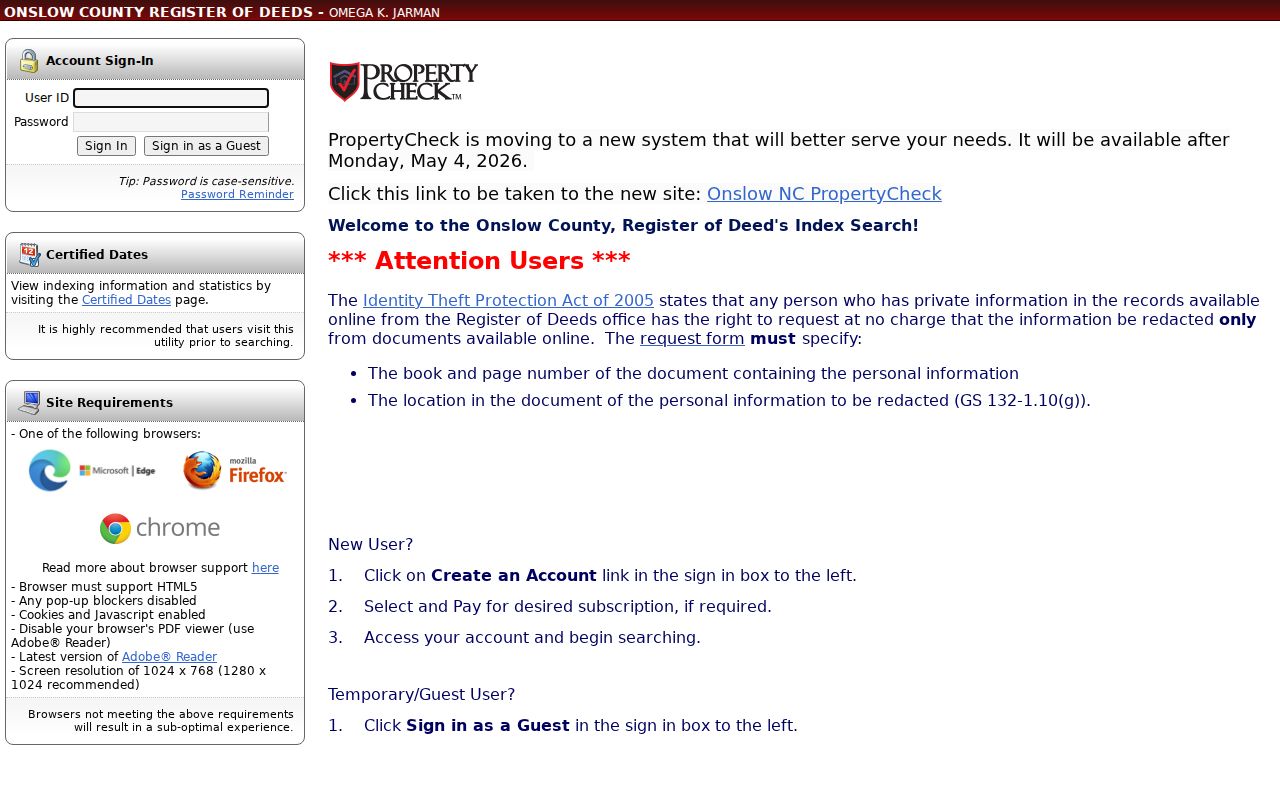
The screen is an index doorway. A result should be checked against the document image, the latest tax roll, and a certified copy when formal proof matters.
| eSearch field or tab | Input | Best use |
|---|---|---|
| Quick Name | Party name | Fast grantor or grantee search |
| Advanced Name | Name and index refinements | Common names and narrower matches |
| Property | Property or legal-description terms | Land without a known party spelling |
| Book/Page Number | Numeric and text pair | Direct document placement |
| File Number | Instrument identifier | Direct filing retrieval |
| Date Range | Recording date pair | Limit a long name-result list |
The certified date inventory sets different online horizons. Births begin in 1857, deaths in 1912, and marriages in 1962. The pre-1995 real-estate index covers 1977 through 1994, while consolidated real property begins in 1995. Earlier land material may require the old-book route, grantor/grantee books, the counter, microfilm, or archives.
Check the eSearch Certified Dates utility before treating a new filing as absent.
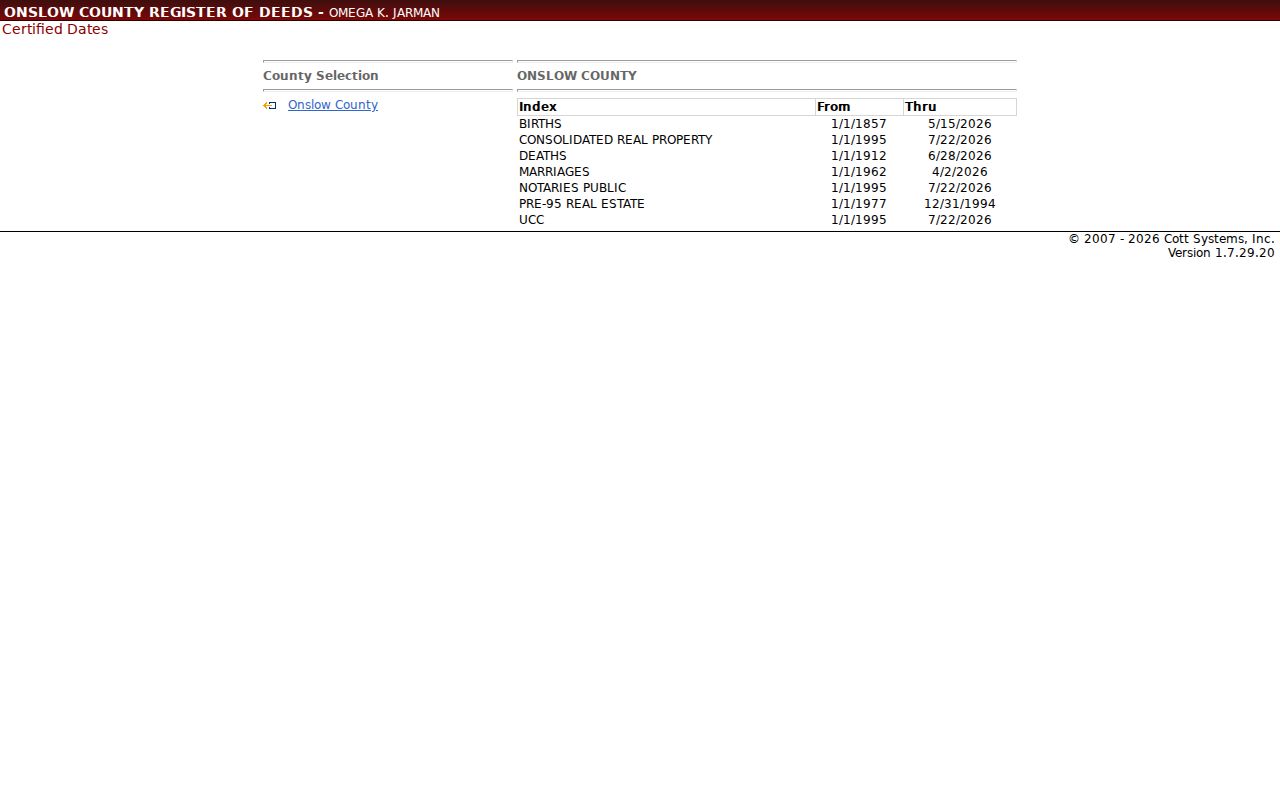
Each index has its own through-date. That practical detail prevents a recent deed, marriage, or notary record from being mistaken for a true miss.
Note: Deed books can be viewable even when a searchable party-name index does not cover the year.
Trace Jacksonville Addresses and Owners
An address trail moves through several county systems. Search the tax roll by owner or property address, record the parcel or account number, and then open the GIS viewer to confirm jurisdiction and map context. Next, find the latest deed by grantee or book and page. Repeat the chain through prior grantors. A tax mailing address, when shown, is where notices go; the situs address is the land itself.
This distinction matters around Jacksonville. A postal address may sit within city limits, the city’s extraterritorial jurisdiction, the Marine base, or unincorporated Onslow County. That choice controls which agency might have a permit or code file. County GIS also warns that ownership shown online may lag a deed while a transfer moves through several departments.
Address trail. Address → tax parcel → GIS jurisdiction → newest deed → prior owners → reverse directory for people who occupied but did not own the property.
The 1961 Hill directory adds something the tax roll cannot: its street guide identifies occupants and businesses by number and marks whether the listed occupant owned the property. Compare both sources before tying a person to the parcel.
Search Jacksonville Court Records
Onslow County District and Superior Courts handle Jacksonville civil, criminal, traffic, family, estate, and special-proceeding matters. The city has no separate municipal court. In eCourts Smart Search, choose Onslow as the location and enter a person, business, nickname, or case number. Wildcard searches require at least three letters of a last name plus an asterisk and one letter of a first name plus an asterisk.
A public docket may show the case number, parties and roles, causes, events, hearings, dispositions, and a Register of Actions, which is the dated list of case activity. Search Hearings and NC Judgment Search answer narrower date and judgment questions. The Judicial Branch court-date tools display the available calendar routes.
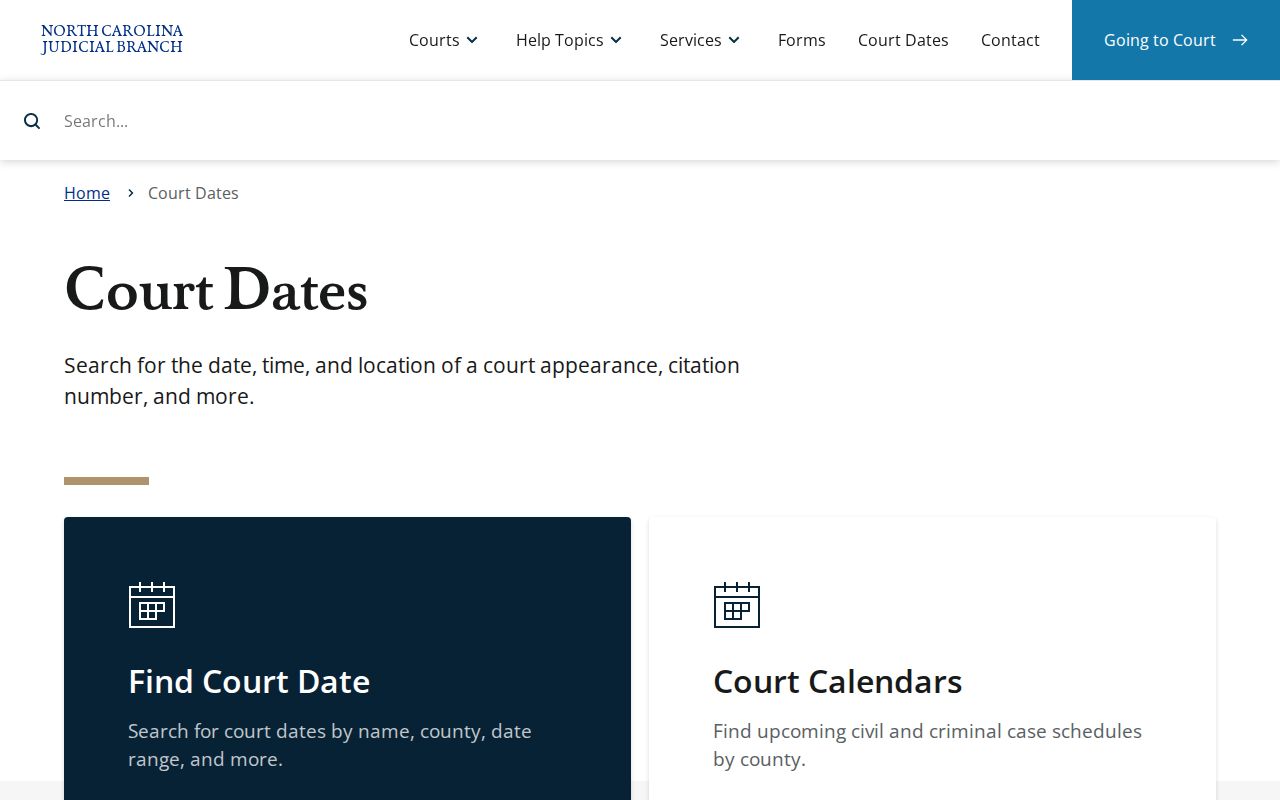
The calendar view is only one channel. Courthouse terminals and the filing clerk remain the fallback for paper files, copies, and records that the public portal does not display.
| Jacksonville court route | Best use | Limit |
|---|---|---|
| eCourts Smart Search | Public party and case summaries | Restricted content stays closed |
| Onslow clerk terminal | Case lookup and file location | Visit or staff request may be needed |
| PACER | Eastern District federal cases | Separate paid federal system |
Juvenile, adoption, sealed, expunged, and protected family or mental-health information is not made public merely because someone visits the courthouse.
Jacksonville Vital Records Paths
Birth, death, and marriage certificates for Onslow events come from the Register of Deeds. Divorce decrees and case files stay with the Clerk of Superior Court, while NC Vital Records can issue a statewide divorce certificate. The certificate is not the full judicial decree. North Carolina does not use one simple rule that closes births for one fixed period and deaths for another.
N.C.G.S. §§130A-93 and 130A-99 separate visible fields, noncertified access, and eligibility for certified copies. A local certified copy costs $10. Eligible requesters generally include the person, spouse, sibling, direct ancestor or descendant, stepparent or stepchild, someone establishing a legal personal or property right, and an authorized representative. A mail request needs the current form, picture ID copy, self-addressed stamped envelope, and cash or money order. Checks are rejected.
- Index
- A name-and-date finding aid that points toward a record. It is not the certified record.
- Certified copy
- An authenticated copy issued by the lawful custodian to an eligible requester.
- Divorce decree
- The court’s filed order, kept by the Clerk rather than the vital-records office.
For older family work, the Tucker Littleton Room holds microfilm of early births and deaths, marriage bonds and licenses, wills, deeds, and court minutes.
Request Missing Jacksonville City Records
Jacksonville uses NextRequest for city records and says email requests are no longer accepted. There is no public master index for city permit files, code cases, cemetery interments, animal licenses, alarm permits, or a citywide business-license register. A missing web search is therefore not proof that the municipal file does not exist.
Name the department and record type. Include an address, approximate date span, person or business name, and a permit or case number when known. Ask for an existing electronic record in the form the city can provide. North Carolina Chapter 132 does not require a motive, but it does allow actual reproduction cost and a special service charge for unusually extensive work.
City limits matter. Code Enforcement covers the city and its extraterritorial jurisdiction, while a Jacksonville mailing address outside those areas may belong to Onslow County. The City Clerk can help route board, cemetery, administrative, and elected-official material. Planning and Permitting handles its own files, and police records created by Jacksonville Police also follow the city request channel.
Note: A focused request is easier to locate and less likely to trigger an extensive-search charge.
Jacksonville Directories Restore Occupants
Property files favor titled owners. That leaves gaps for nonowners, lodgers, service members, and family members who shared a home. Jacksonville’s directory trail fills some of those gaps. Digitized volumes survive for 1948, 1957, 1958, 1960, 1961, and 1963. The Tucker Littleton Room has a physical city-directory run from 1960 through 2019, telephone books from 1957 to the present, and local newspapers from 1938 forward.
The 1961 reverse section is especially useful. It is arranged by street and number, then names the occupant or business, indicates whether the occupant owned the property, and shows a telephone marker. Old print and OCR can misread initials or thin type, so inspect the scanned page after a keyword hit. Try name variants, initials, spouse or widow notation, occupation, and nearby street numbers.
The Camp Lejeune acquisition story shows why ownership alone can mislead. After the 1940 base decision, the Register of Deeds stayed open late for condemnation and deed work. About 700 families were displaced, but sharecroppers without title did not appear as compensated owners. Census, church, school, newspaper, and directory records are needed to recover those residents.
A deeper directory-by-directory route is available through the Jacksonville people directories.
Search Jacksonville Custody Records
Current Onslow County custody information is app-only. The Sheriff does not publish its jail roster or mugshots on the county website. Use the Sheriff mobile app’s Jail Info route or call the booking desk at 910-937-1470. The Detention Division at 717 Court Street can answer jail and visit questions at 910-937-1475.
State prison, probation, and parole records use the NC Department of Adult Correction search, which includes history to 1972. It does not include the county jail. Federal custody uses the federal locator. The SBI registry is another separate system with name, address-radius, coordinate, and registration-number searches. Its records cover registered persons only.
An arrest, booking, prison record, registry entry, and court disposition each has a different legal meaning. Check the Onslow eCourts case before treating a custody record as proof of an outcome. Police reports also follow the agency that made the record: Jacksonville Police through city NextRequest, and Sheriff incidents through the Sheriff’s records channel.
Jacksonville Business and Money Searches
A business name can expose a useful public trail. The North Carolina Secretary of State search lists entities, status, formation details, registered agents, officials, addresses, and filing history. Assumed-name filings made on or after December 1, 2017 appear in the statewide compilation and can be filtered to Onslow. Earlier assumed-name records require the Register of Deeds.
Professional status belongs with the board that regulates the field. North Carolina has separate official lookups for medicine, nursing, law, general contracting, real estate, cosmetic arts, and other licenses. Each board decides which fields and discipline details are public, so one portal’s display should not be assumed for another.
The official NC Cash name search can also connect a person or business to unclaimed funds.
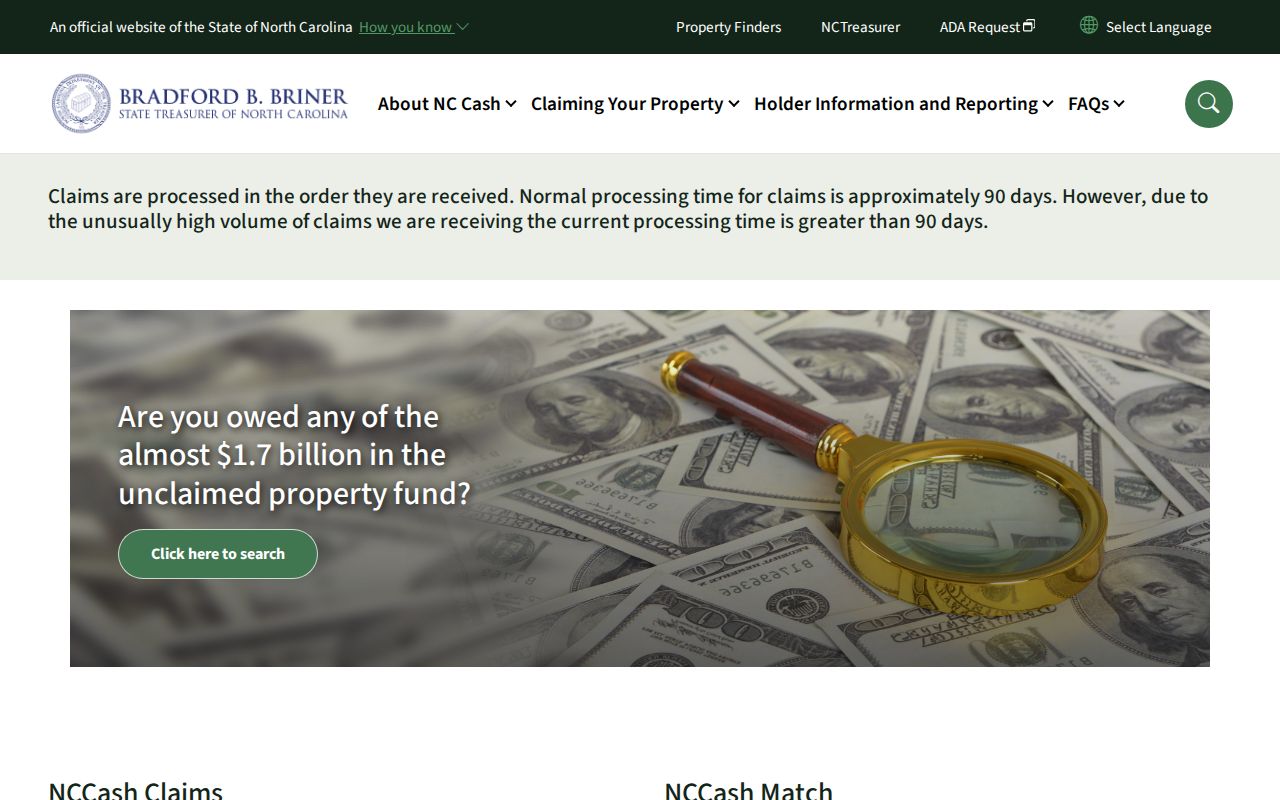
A match is a lead, not automatic ownership. The Treasurer requires identity proof before paying a claim, and an old address or business name should be compared with another dated record.
When Jacksonville Online Records Miss
An empty result has several causes. The wrong office may hold the file. The index may begin after the event. A new filing may fall beyond its certified through-date. Spelling may vary. The record may be app-only, counter-only, archived, sealed, expunged, or protected by statute. One blank screen cannot distinguish among them.
Move through the access channels in order. Confirm the custodian and online coverage. Try a narrower name, date, address, parcel, case, or book-and-page search. Call the office for the correct index and copy method. Use the counter or mail for records not delivered online. For old deeds, elections, court lists, and family material, use library microfilm or the State Archives inventory.
| Source type | Strength | Best fallback |
|---|---|---|
| Official index | Direct custodian and defined fields | Counter, image, or certified copy |
| Commercial compilation | Fast cross-source lead | Verify at the originating office |
| Historic directory | Dated occupant and address snapshot | Newspaper, census, deed, or vital record |
Commercial compilations can be stale or merge two people. Never let speed replace a match on role, date, address, and the original public record.
Guard Jacksonville Search Information
Use names, addresses, and records only for lawful personal research. Do not stalk, threaten, track, or harass anyone. North Carolina law addresses stalking, cyberstalking, and identity theft, and the SBI registry carries its own misuse warning. Immediate threats belong with 911, not a public lookup.
The North Carolina Address Confidentiality Program gives eligible survivors a substitute address and forwards first-class mail. State and local agencies must keep the actual address out of public records. Protected voter addresses remain confidential. Do not attempt to reverse a substitute address through property, voter, or directory searches.
Records can also make scams sound credible. Onslow warned about impostors posing as vacant-land owners, jury callers demanding payment, and fake detention staff seeking app-based bond payments. Verify through a published government number. The Sheriff does not take bond payments at the detention desk.
Lawful personal use. Public access supports genealogy, reconnection, estate work, scam checks, and civic review. It never authorizes harm or an effort to defeat a protected address.